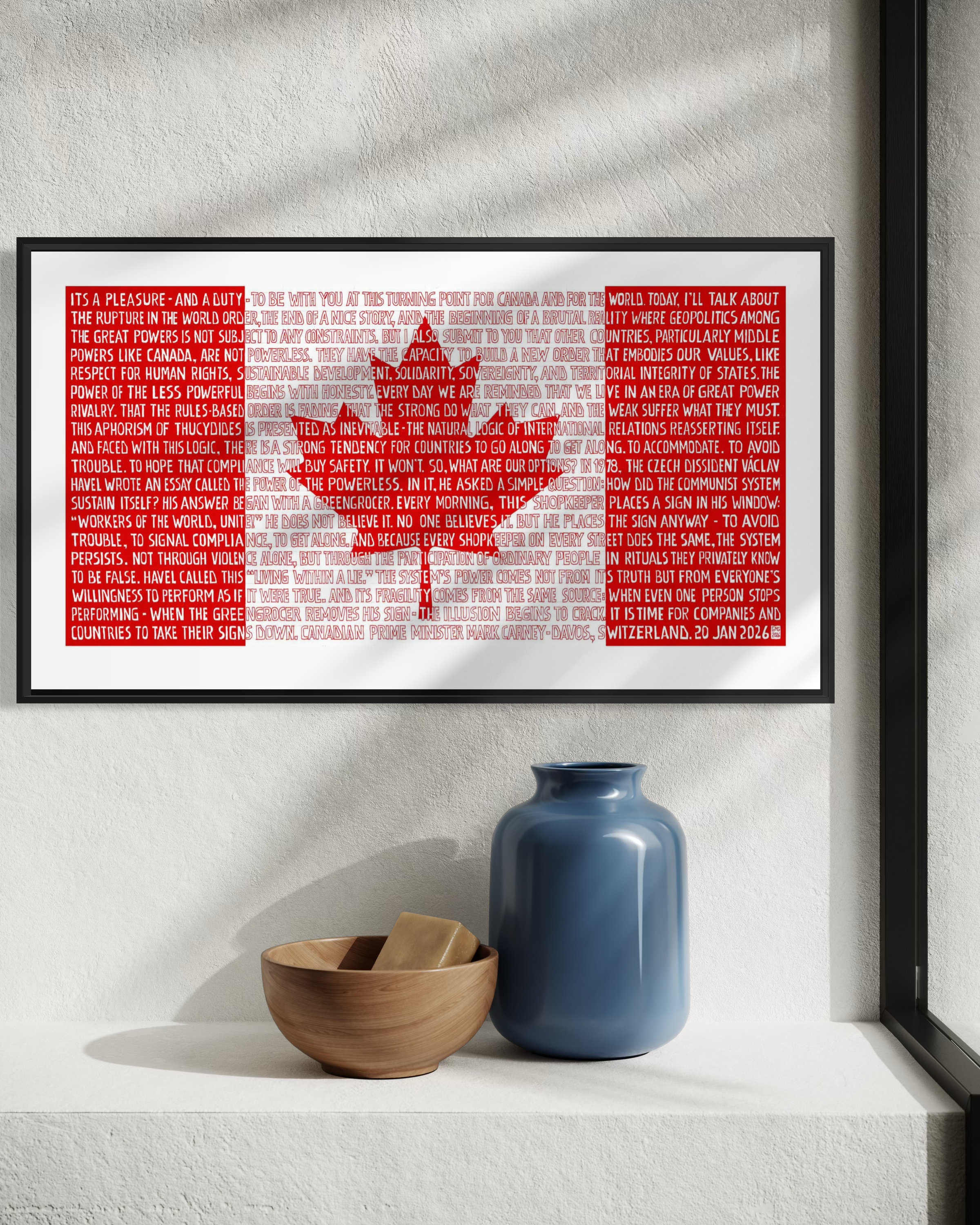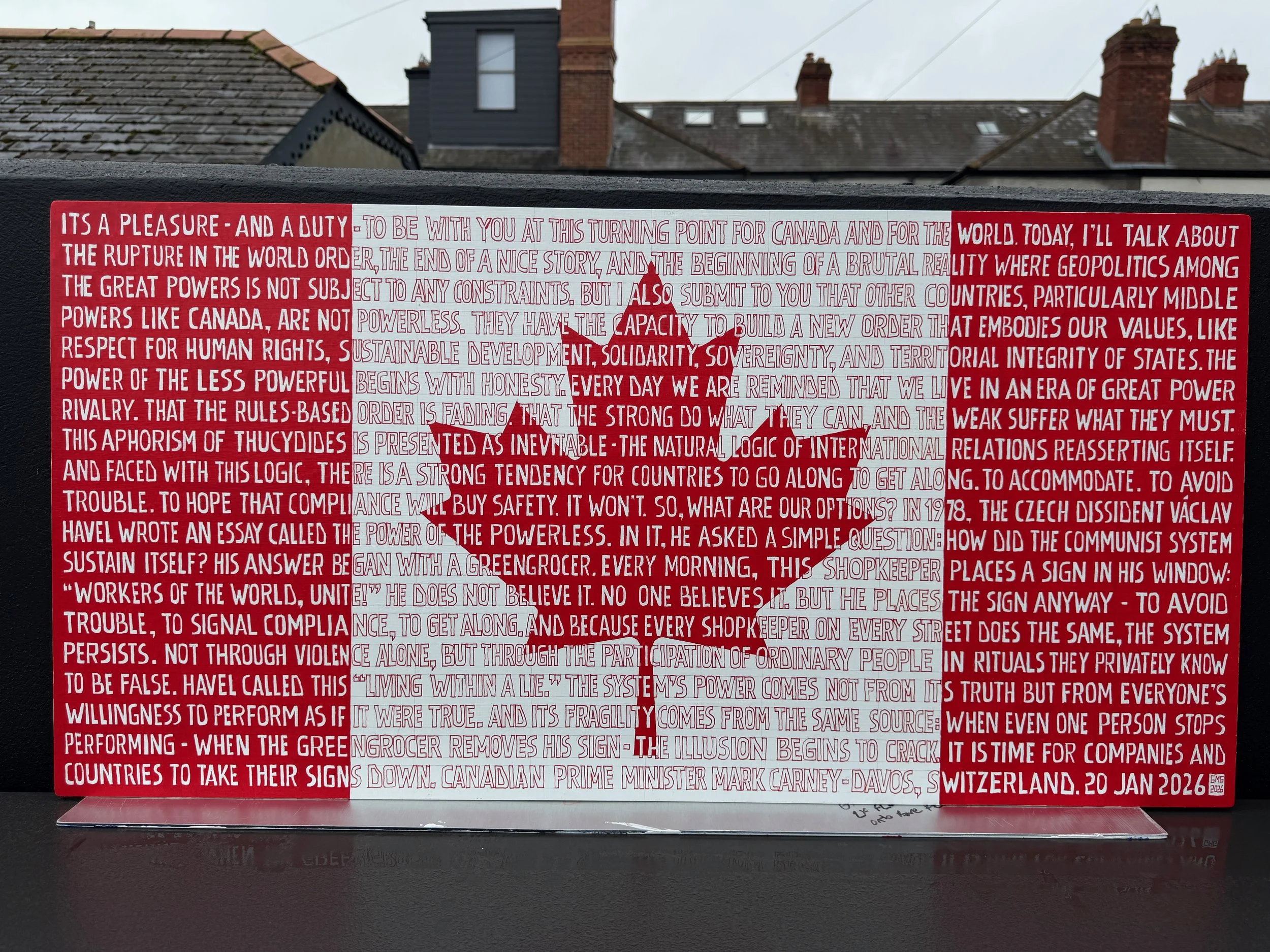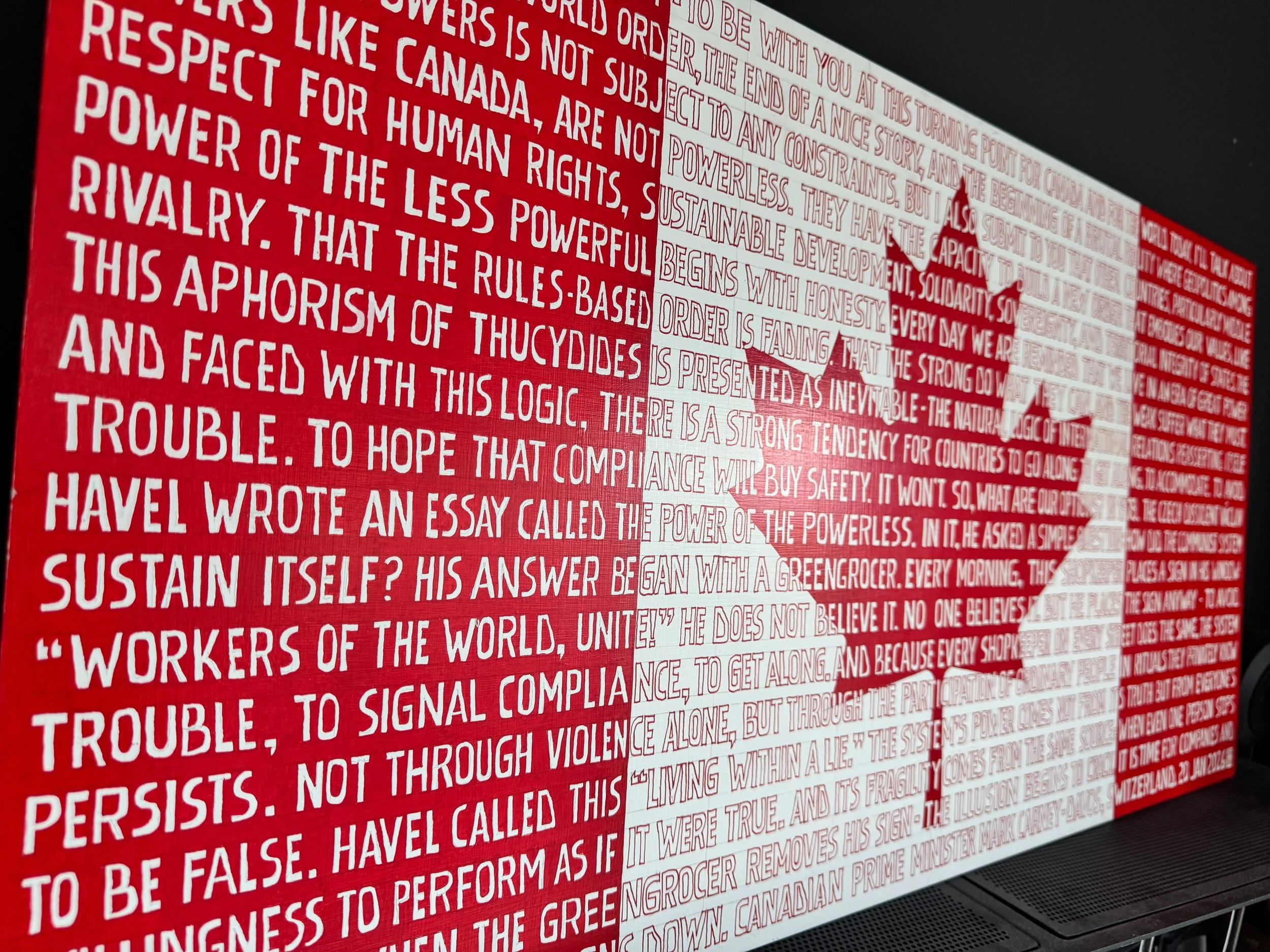
SPOKEN STATE - CANADA

Mark Carney's Davos address 'Principled and Pragmatic: Canada's Path' (January 2026)

The Work

MEDIUM

Acrylic on Dibond aluminium

DIMENSIONS

915 × 457 mm (1:2 ratio)

COLOURS

Cadmium Red (Hue), Titanium White

SPEECH

Principled and Pragmatic: Canada's Path, 20 January 2026

SPEAKER

MARK CARNEY

LOCATION

DAVOS, SWITZERLAND

About the flag

The Canadian Maple Leaf — red, white, red in equal vertical bands with a stylised 11-point maple leaf at centre. Adopted 1965. Ratio 1:2.

The Text on the Painting

The work uses a single sustained extract from Carney's address — 382 words, beginning at the opening of the speech and ending with the call to action. The extract is painted in full on the work, word by word across the three colour fields of the Canadian flag.

"In 1978, the Czech dissident Václav Havel wrote an essay called The Power of the Powerless. He asked a simple question: how did the Communist system sustain itself? His answer began with a greengrocer. Every morning, this shopkeeper places a sign in his window: Workers of the World, Unite! He does not believe it. No one believes it. But he places the sign anyway — to avoid trouble, to signal compliance, to get along. Havel called this Living Within a Lie. It is time for companies and countries to take their signs down."  — Mark Carney, Davos, January 20, 2026

Historical Context

The moment: World Economic Forum Annual Meeting, Davos, Switzerland. January 20, 2026 — the first anniversary of Donald Trump's return to the White House.


Mark Carney became Prime Minister of Canada in March 2025, replacing Justin Trudeau at the moment of maximum pressure on the Canada–US relationship. Trump had threatened sweeping tariffs on Canadian goods, floated making Canada the 51st state, and applied sustained economic and rhetorical pressure on one of America's closest allies. Carney won the subsequent federal election in April 2025 — partly on the strength of his reputation as former Governor of both the Bank of Canada and the Bank of England, and partly on a clear message of Canadian resilience and sovereignty.

On January 20, 2026 — one year to the day after Trump's second inauguration — Carney addressed the World Economic Forum in Davos. The date was deliberate. The speech he chose to give was not a polite diplomatic address. It was a clear-eyed diagnosis of a broken world order and a call to action for middle powers willing to stop pretending.

The speech's centre of gravity is the Havel passage — an act of intellectual courage in a room full of people who have spent years placing signs in windows. Carney named what everyone in the hall knew but few had said aloud: that the rules-based international order had been a useful fiction, that compliance had not bought safety, and that the time to take the signs down was now.

The speech was compared by commentators to Churchill's Iron Curtain address at Fulton, Missouri — another moment when a leader named a rupture that others were still calling a disagreement. That comparison is not incidental to this work: the Spoken State series already contains a Churchill. The Canada and UK works, hung facing each other, create a precise historical argument across 80 years.

The Power of the Powerless

Václav Havel published The Power of the Powerless in 1978 as an underground samizdat essay in Communist Czechoslovakia. It became one of the defining texts of Central European dissent — and eventually helped inspire the Velvet Revolution of 1989, which brought Havel himself to the presidency.

The essay's central argument — that authoritarian systems sustain themselves not through force alone but through the daily compliance of ordinary people, and that one person's refusal to comply can crack the entire edifice — has lost none of its force. Carney's use of it at Davos in 2026, addressed to the heads of government and finance of the world's most powerful nations, was a provocation: you are the greengrocer. Stop placing the sign.

The Spoken State series will contain a Czechoslovakia work — Václav Havel's own 1990 New Year Address. The Canada and Czechoslovakia works, placed in the same exhibition, create a direct conversation: Havel's original argument in 1990, and Carney's invocation of it in 2026. The series contains this dialogue within itself.The essay's central argument — that authoritarian systems sustain themselves not through force alone but through the daily compliance of ordinary people, and that one person's refusal to comply can crack the entire edifice — has lost none of its force. Carney's use of it at Davos in 2026, addressed to the heads of government and finance of the world's most powerful nations, was a provocation: you are the greengrocer. Stop placing the sign.

"Living Within a Lie. The system's power comes not from its truth but from everyone's willingness to perform as if it were true. And its fragility comes from the same source: when even one person stops performing — when the greengrocer removes his sign — the illusion begins to crack."  — Václav Havel, The Power of the Powerless, 1978 · as quoted by Mark Carney, Davos, 2026

“Principled and pragmatic: Canada’s path” Prime Minister Carney addresses the World Economic Forum Annual Meeting

The real story behind the Canadian Flag

History of Canada’s National Flag

Process

Each Spoken State work begins with the speech. The text is transcribed, counted, and mapped to the geometry of the flag — word by word, colour field by colour field — before a single brushstroke is made.

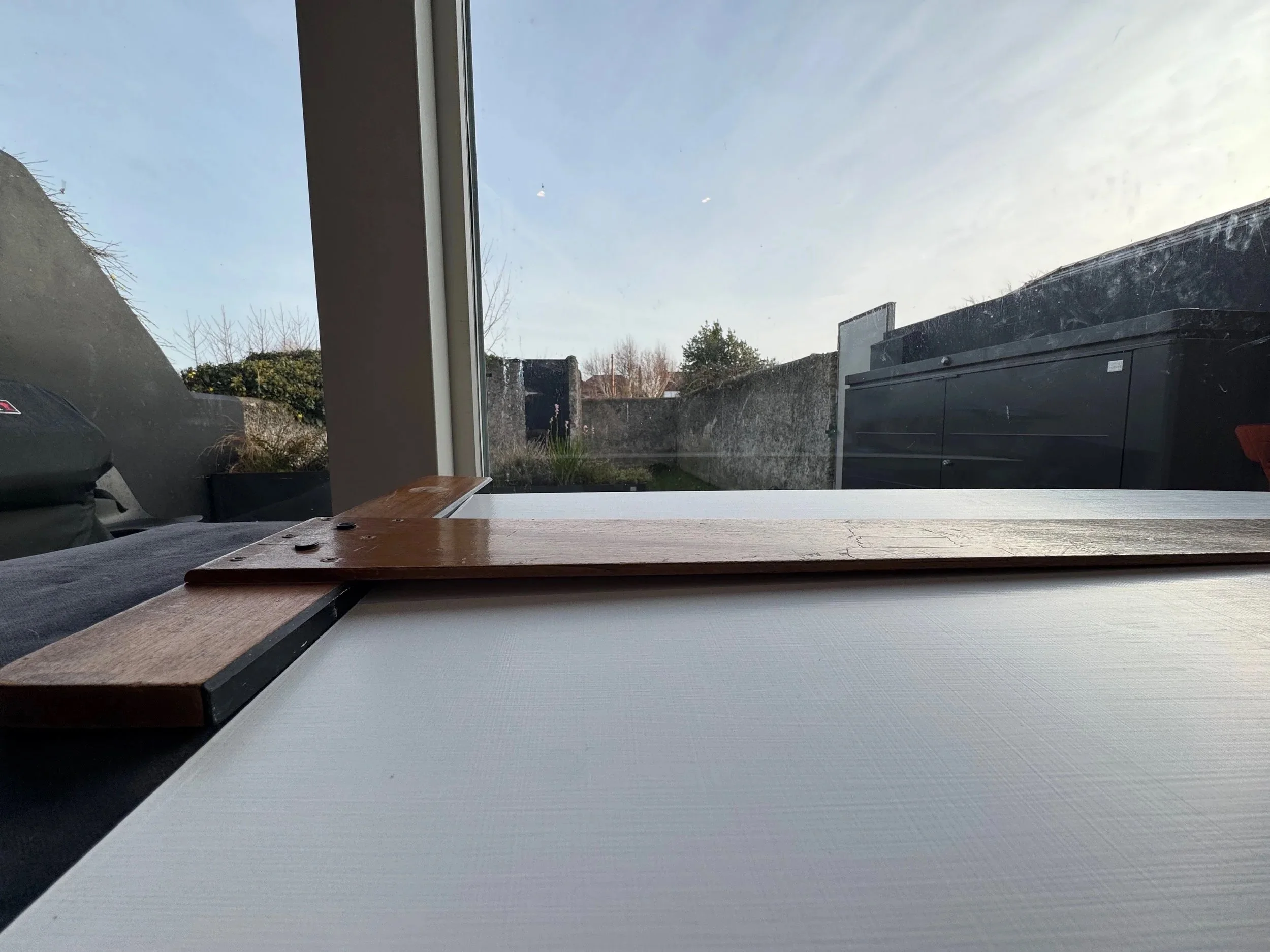
1.  The Aluminium Dibond is sized to the width of McGinty’s 30 year old T Square. The aluminium surface is lightly sanded, primed and 4 coats of gesso with a final two coats of Titanium White to create the the surface on which to work. The Surface becomes a drawing board.

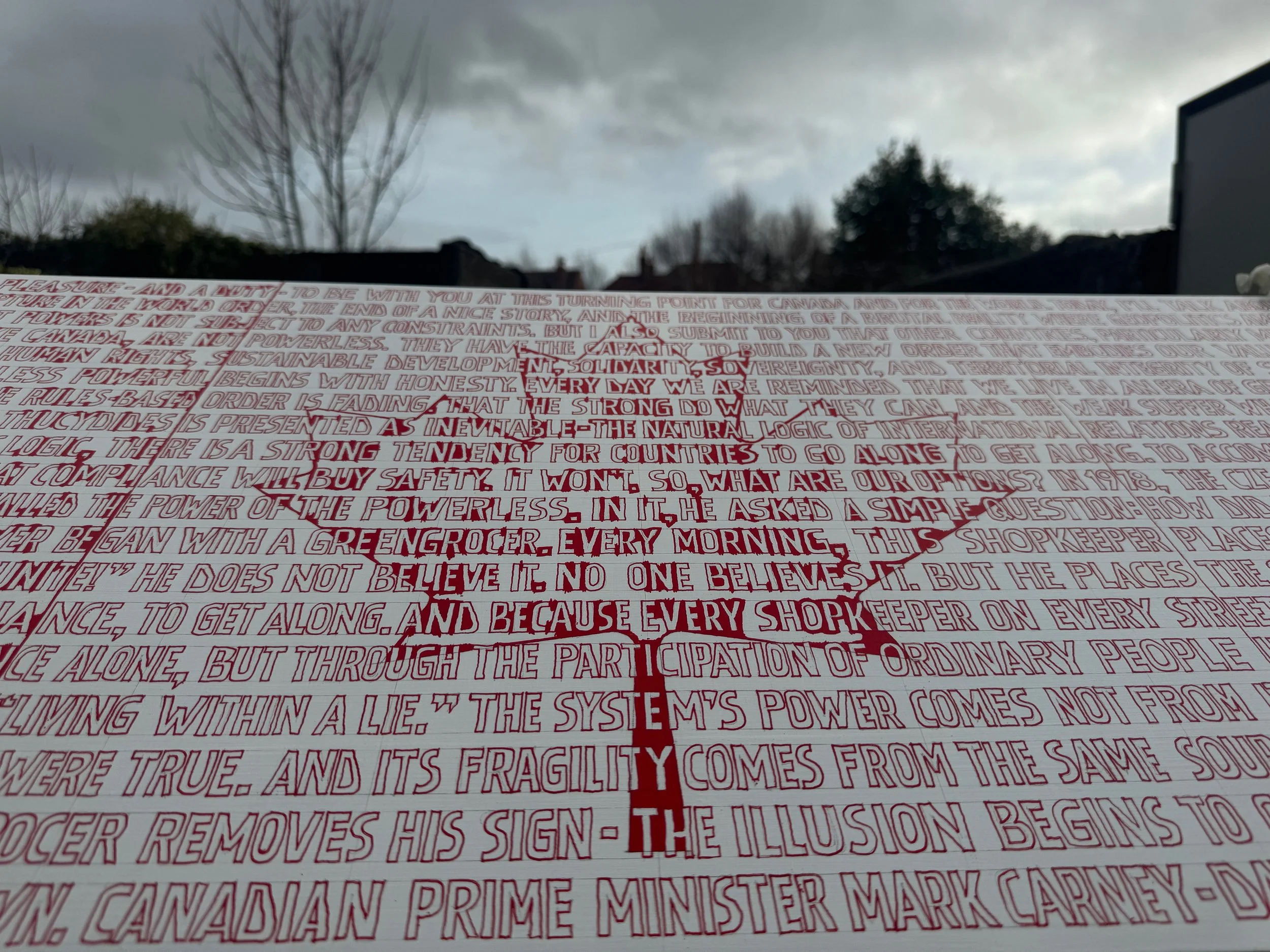
1.  Using a T-Square and pencil the speech is mapped word by word in pencil across the three colour fields of the Canadian Flag. Word size, spacing, and density were calibrated so the text reads as pure colour field at distance, resolving into language only on close approach. The extract — 382 words, from the opening of the speech to the 'take their signs down' call to action — was selected for its self-contained argument. It opens with Carney's declaration of the moment, moves through Thucydides and Havel, and arrives at the imperative. It is a complete thought.

2.  The maple leaf — the defining element of the Canadian flag — sits at the centre of the white band. The Havel greengrocer passage is concentrated within and around the leaf form. The metaphor is embedded in the geometry: the central symbol of Canadian identity holds the argument about what it means to remove the sign.

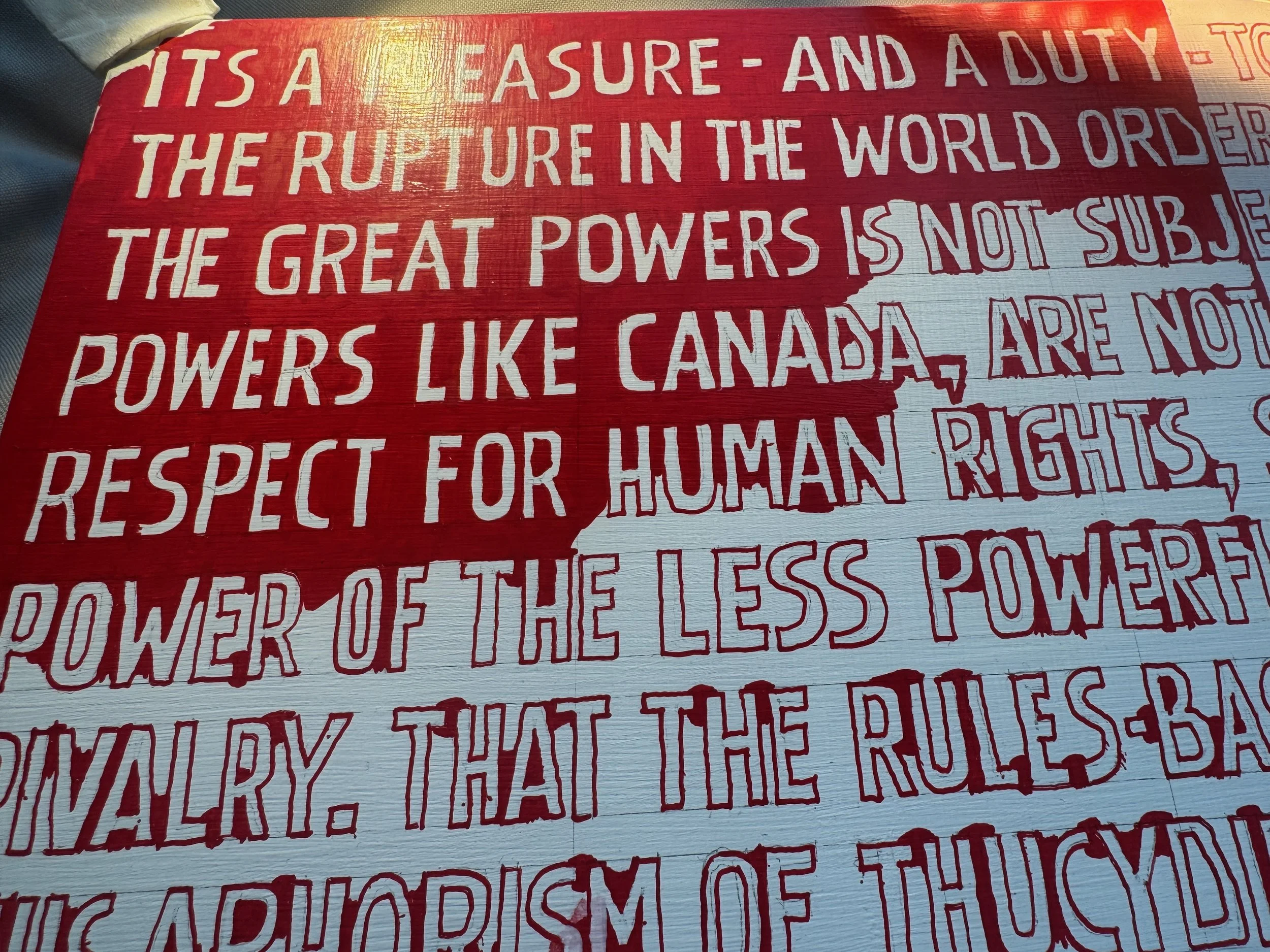
3.  Text density was calibrated so the red fields carry the opening and closing arguments at full density, while the white band — the leaf zone — uses wider spacing so the leaf geometry remains legible at distance.

4.  Cadmium Red (Hue) and Titanium White on Dibond aluminium at 915mm width. The attribution line — CANADIAN PRIME MINISTER MARK CARNEY · DAVOS, SWITZERLAND · 20 JAN 2026 — is worked into the final line of the painting, as in all completed works in the series.

Limited Edition Prints

The Original Flag Painting is scanned using a museum quality, high resolution Cruse scanner.
Limited edition museum quality archival prints are available, signed and numbered by the artist.

[ BUTTON: 'ENQUIRE ABOUT PRINTS' → /contact ]

[ BUTTON: 'VIEW ALL EDITIONS' → /editions ]

← Previous flag | View all works | Next flag →